Being self-employed does not close the door to a mortgage. The products are the same as for an employee: fixed, variable or mixed, at the same rates. What changes is how much you have to prove. And almost everything is decided by one document: your income tax return.
Can a self-employed person get a mortgage?
Yes. There is no such thing as a separate “mortgage for the self-employed (autónomos)”: banks offer the same mortgages, but they analyse your file in more detail because your income does not arrive as a fixed salary.
Spain's Law 5/2019 requires the bank to assess your creditworthiness before granting the loan, taking into account, among other factors, your employment situation and your current and foreseeable income (article 11). For an employee, that means a contract and payslips. For the self-employed, it means your taxes.
How the bank calculates your income
This is the point that surprises the self-employed the most:
- It does not count your turnover. The bank starts from the net income you declare in your income tax return (IRPF), that is, what is left after deducting your deductible expenses.
- It takes an average. The usual approach is to take the last two tax years declared. If your income is rising, that works in your favour; if it is falling, the bank looks at the weaker year.
- It applies the 30-35% rule. The Bank of Spain points out that lenders usually consider that the sum of your repayments (mortgage and other loans) should not exceed 30-35% of your net income. It is a risk criterion used by banks, not a law.
The direct consequence: every expense you deduct lowers your taxes, but also the income the bank takes into account.
Example: same activity, different mortgage
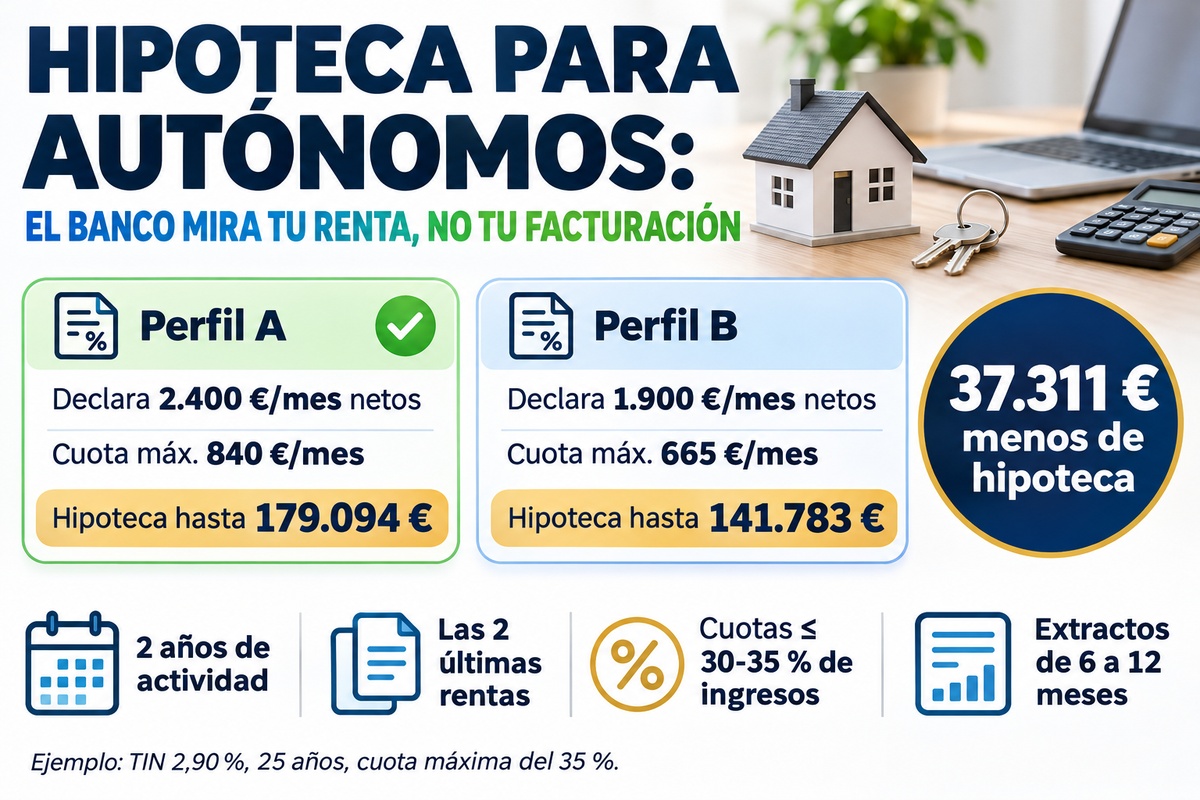
Two self-employed people with a similar activity. The first declares a net income of €2,400 a month; the second has deducted more expenses and declares €1,900 a month. With a maximum repayment of 35%, a nominal rate (TIN) of 2.90% and a 25-year term, this is what the bank could lend them:
| Item | Profile A | Profile B |
|---|---|---|
| Declared monthly net income | €2,400 | €1,900 |
| Maximum repayment (35%) | €840/month | €665/month |
| Approximate maximum mortgage | €179,094 | €141,783 |
The difference: about €37,311 less mortgage for profile B, simply because of how their income is reflected in the tax return. And if profile A also paid €150 a month for a car loan, their maximum mortgage would drop to about €147,113.
Illustrative example with fictitious income: nominal rate (TIN) of 2.90%, 25 years, maximum repayment of 35% and no other debts except where stated. Each bank applies its own calculation criteria.
Track record: the two-year barrier
Most banks ask for at least two years of activity as self-employed, proven by your Social Security work history (vida laboral) and two complete income tax returns. The reason is simple: with two tax years, the bank can see a trend.
With a shorter track record it is not impossible, but it is harder. Growing turnover, well-kept accounts, good savings or a salaried co-borrower all help. And the longer your track record, with stable or rising income, the more your profile looks like an employee's to the bank.
The documents you will be asked for
Arriving with a complete file from day one gives an impression of reliability and saves weeks:
- DNI or NIE of all borrowers.
- Work history report (vida laboral), which proves how long you have been registered in the self-employed scheme (RETA).
- Income tax returns (IRPF) for the last two tax years.
- Quarterly returns for the current year: form 130 (modelo 130, income tax prepayments) and form 303 (modelo 303, VAT).
- Certificates showing you are up to date with the Tax Agency and Social Security.
- Bank statements for the last 6 to 12 months, for your personal and business accounts.
- Contracts with recurring clients or a short description of your activity, if you have them.
- Repayment receipts for other loans in progress.
The bank will also check the Bank of Spain's risk register (CIRBE) and the default registers.
The mistakes that most often hold back a self-employed mortgage
- Applying right after a highly optimised tax return. If you have deducted a lot this year, the bank will see a lower income.
- Mixing personal and business expenses in the same account: the statements become hard to read.
- Figures that do not match between the tax return, the quarterly returns and the statements.
- Small debts that add up: revolving credit cards, consumer loans, deferred payments with the Tax Agency.
- Handing in documents bit by bit, incomplete or out of date.
- Applying to a single bank. Each lender has its own appetite for self-employed profiles, and the difference between them can be large.
How to improve your chances
- Plan ahead. If you are thinking of buying in one or two years, discuss it with your tax adviser: deductions affect what the bank will see.
- Put in more savings. The smaller the amount you borrow, the easier it is to stay within 30-35%.
- Consider a salaried co-borrower. Their stable income strengthens the application; bear in mind, though, that you are both liable for the whole debt.
- Reduce your debts before applying. Every repayment you eliminate frees up capacity for the mortgage. For more ideas, here is how to improve your bank profile.
- Check whether you meet the requirements for the Aval ICO, which can help you finance more than 80% of your first home.
- Compare several lenders. We explain how in our article on comparing mortgages.
The Duplo Capital advantage
A well-prepared self-employed borrower does not have to settle for their bank's first answer.
Frequently asked questions about mortgages for the self-employed
Banks usually ask for two complete tax years declared. With a shorter track record it is possible in some cases, especially if your turnover is growing, you have good savings or you buy with a salaried co-borrower.
At what you declare. It starts from the net income of your activity in your income tax return (IRPF), usually the average of the last two years, not from what you invoice.
As a guide, the sum of your repayments, mortgage included, should not exceed 30-35% of your net income. It is a criterion used by banks, not a legal rule, and each lender applies it in its own way.
Lenders usually finance up to 80% of the property's value, but some go further for solid profiles, and the Aval ICO can help you if you meet its requirements. It depends on your income and how solid your activity is.
Yes: their stable income strengthens the creditworthiness of the file. In return, both borrowers are liable for the whole debt, not just half of it.
Work history (vida laboral), your last two tax returns, forms 130 and 303 for the current year, certificates showing you are up to date with the Tax Agency and Social Security, and 6 to 12 months of bank statements. The more complete and organised, the better.
Want to know which mortgage you can get?
Request your free analysis and we'll tell you in under 48 hours.
REQUEST MY FREE ASSESSMENT