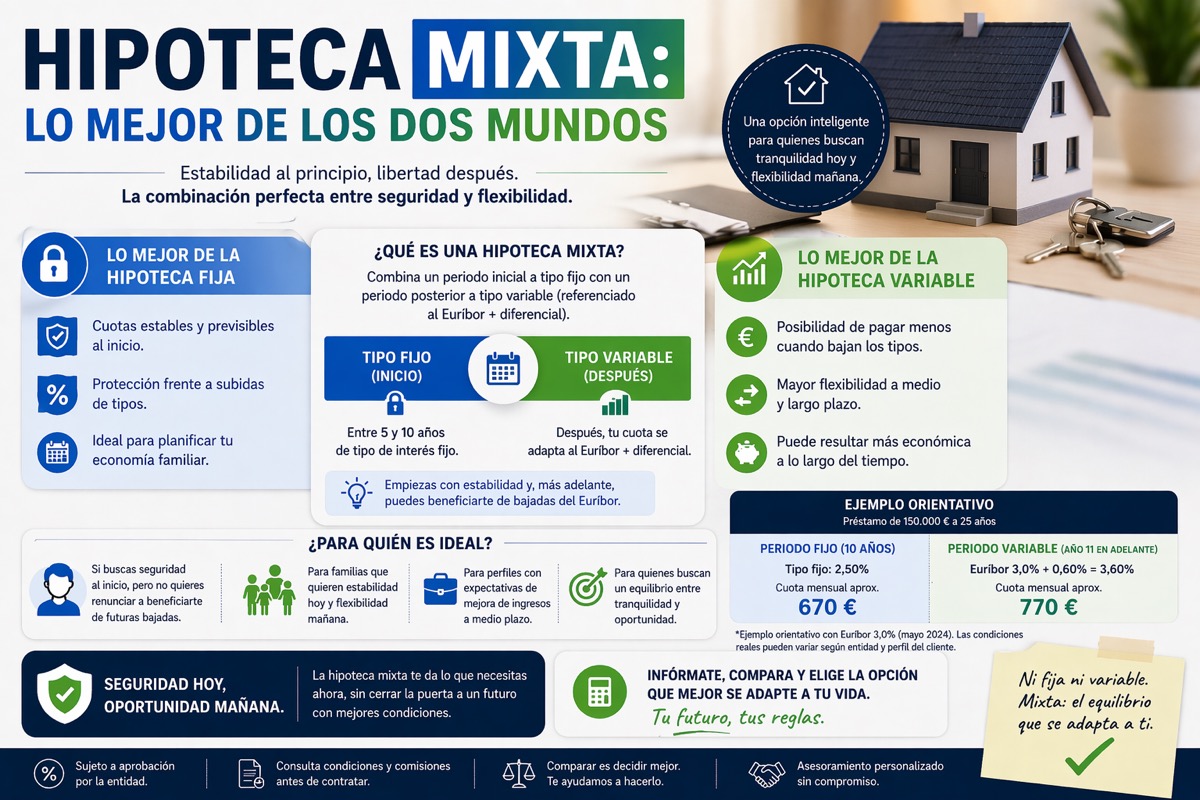
The mixed rate mortgage has become the most popular option in Spain in recent years. It combines an initial fixed-rate period with the remainder of the loan at a variable rate, offering security at the start and flexibility in the long term.
How does a mixed rate mortgage work?
During the first years (usually between 3 and 15 years depending on the bank), you pay a fixed, unchanging monthly payment. Once that period ends, the mortgage becomes variable, referenced to the Euríbor plus a negotiated spread.
Practical example: a 25-year mixed mortgage with a 5-year fixed period means your payment doesn't change for the first 5 years. From year 6, your payment is reviewed every 6 or 12 months based on the Euríbor.
What do banks look at?
To approve a mixed rate mortgage, banks assess:
- Debt capacity — Monthly payments must not exceed 35% of the household's net monthly income.
- Job stability — Permanent contract or civil servant with minimum tenure. Self-employed with at least 2 years of established activity.
- Available savings — Minimum 20% of the purchase price plus purchase costs (6-15% depending on the region).
- Credit history — No defaults or entries in delinquency registers.
- Appraisal value — The bank finances based on the lower of purchase price and appraisal.
When is a mixed rate mortgage the right choice?
A mixed rate is particularly attractive when:
- The Euríbor is high but expected to fall in the medium term.
- You want protection during the first years of greatest economic uncertainty.
- You plan to pay off part of the capital during the fixed period.
- You're looking for a balance between the security of fixed and the potential savings of variable.
The Duplo Capital advantage
Duplo Capital analyses your financial situation and negotiates with over 20 banks to find the mixed mortgage with the best fixed period and the most competitive spread on the market.
Frequently asked questions about mixed-rate mortgages
A mixed-rate mortgage is a loan that combines an initial fixed-rate period with a variable rate for the rest of the term. During the fixed period you pay an instalment that does not change, whatever happens to interest rates. Once that period ends, the loan is linked to the Euribor plus a margin negotiated with the bank. The aim is to get certainty in the early years and flexibility over the long term.
The fixed period usually lasts between 3 and 15 years, depending on the bank. Each lender sets its own options, and the fixed rate may vary with the length you choose. For example, on a 25-year mortgage with 5 fixed years, the instalment does not change during those first 5 years. The right length depends on your profile and on how long you want your instalment locked in.
When the fixed period ends, the mortgage switches to a variable rate: the Euribor plus the margin agreed in the contract. From then on, the instalment is reviewed every 6 or 12 months, depending on your contract. If the Euribor rises, the instalment goes up; if it falls, the instalment goes down. That is why it pays to negotiate the margin carefully from the start, since it applies throughout the variable period.
Above all, banks look for an affordable instalment, job stability and enough savings. As a guide, the instalment should not exceed 35% of the household's net monthly income. A permanent contract or civil-servant status is valued, and self-employed applicants usually need at least 2 years of established activity. You will also generally need to contribute at least 20% of the price plus the purchase costs, which range from 6% to 15% depending on the autonomous community, and you must not appear on any defaulters' register.
A mixed-rate mortgage usually suits you if you want a balance between the certainty of a fixed rate and the potential savings of a variable one. It can be worthwhile when the Euribor is high but expected to fall in the medium term, or if you want protection in the early years. It also makes sense if you plan to repay part of the capital during the fixed period. The best choice depends on your profile, which is why Duplo Capital compares fixed, variable and mixed options and simulates your instalment in both periods before you decide.
Yes, you can make early repayments during the fixed period, although the bank may charge a fee. Spain's Ley 5/2019 on real estate credit caps the maximum amount of these fees, and the applicable limit depends on the terms of your contract. The early repayment conditions are set out in the FEIN (European Standardised Information Sheet), which the bank must give you before signing. If you plan to repay early, take this into account when comparing offers.
Is a mixed rate mortgage the best option for you?
Request your free analysis and we'll tell you in under 48 hours.
REQUEST MY FREE ASSESSMENT