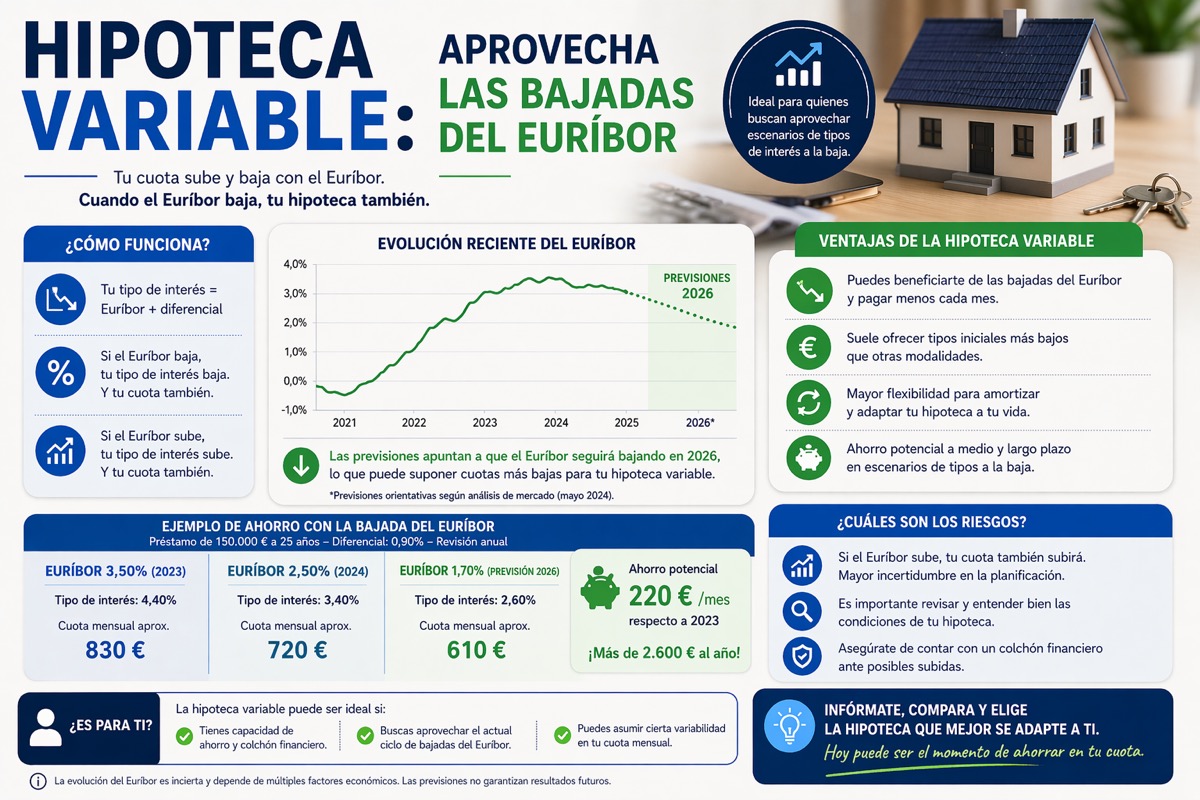
The variable rate mortgage has historically been the most popular in Spain. Its main appeal is a lower initial interest rate, with the potential to save significantly when the Euríbor falls. However, it means accepting some uncertainty in monthly payments.
How does a variable rate mortgage work?
The interest rate on a variable mortgage is made up of two parts: the Euríbor (European reference index) plus a fixed spread negotiated with the bank. The payment is reviewed every 6 or 12 months based on the Euríbor's evolution.
Practical example: if your mortgage is Euríbor + 0.75% and the Euríbor is at 2.5%, you pay a total interest of 3.25%. If the Euríbor drops to 1.5%, your payment is automatically reduced at the next review.
What do banks look at?
To approve a variable rate mortgage, banks analyse:
- Debt capacity — Payments must not exceed 35% of net income, also calculated with a high Euríbor scenario to ensure you can handle increases.
- Job stability — Preferably permanent contract or civil servant. Self-employed with at least 2 years of established activity.
- Available savings — Minimum 20% of purchase price plus purchase costs (6-15% depending on region).
- Credit history — No outstanding debts or entries in delinquency registers.
- Appraisal value — The bank finances based on the lower of purchase price and appraisal.
When is a variable rate mortgage the right choice?
A variable rate is particularly attractive when:
- The Euríbor is at high levels but trending downward.
- You plan to make early repayments on part of the capital.
- Your financial situation allows you to absorb potential payment increases.
- You're looking for the lowest possible interest rate in the short term.
The Duplo Capital advantage
Duplo Capital negotiates with over 20 institutions to get you the most competitive spread on the market, minimising the cost of your variable mortgage regardless of where the Euríbor stands.
Frequently asked questions about variable-rate mortgages
If the Euribor rises, your monthly payment will go up at the next review, which takes place every 6 or 12 months depending on your contract. The margin agreed with the bank does not change; what varies is the Euribor it is added to. That is why banks assess your repayment capacity under a high-Euribor scenario, to make sure you can absorb possible increases.
It is calculated by adding the Euribor, the European benchmark index, to a fixed margin negotiated with the bank. For example, if your mortgage is Euribor + 0.75% and the Euribor stands at 2.5%, you pay a total interest rate of 3.25%. If the Euribor falls, your total rate and your monthly payment go down automatically at the next review.
It makes most sense when your finances allow you to absorb possible payment increases. It is often attractive when the Euribor is high but trending downwards, when you plan to repay part of the capital early, or when you want the lowest possible rate in the short term. The choice depends on your profile, your term and market conditions, so it is worth comparing it with a fixed or mixed-rate mortgage.
No, Spain's Law 5/2019 on Real Estate Credit Agreements prohibits setting a lower limit on the interest rate of variable-rate mortgages. So if the Euribor falls, the decrease is reflected in your rate at the next review. The same law does, however, state that the mortgage interest rate cannot be negative.
Above all, repayment capacity, job stability, savings and a clean credit history. The monthly payment should not exceed 35% of net income, also calculated under a high-Euribor scenario, and you will normally need at least 20% of the purchase price plus the purchase costs (between 6% and 15% depending on the autonomous community). A permanent contract or civil-servant status is preferred, and self-employed applicants are expected to have an established business of at least 2 years.
The margin is the fixed part of the rate that you negotiate with the bank and that is added to the Euribor at each review. Because it stays as agreed in the contract, it affects every payment over the life of the loan, whether the Euribor is high or low. Duplo Capital negotiates with more than 20 lenders to secure a competitive margin and simulates high, medium and low Euribor scenarios before you decide.
Is a variable rate mortgage the best fit for your situation?
Request your free analysis and we'll tell you in under 48 hours.
REQUEST MY FREE ASSESSMENT