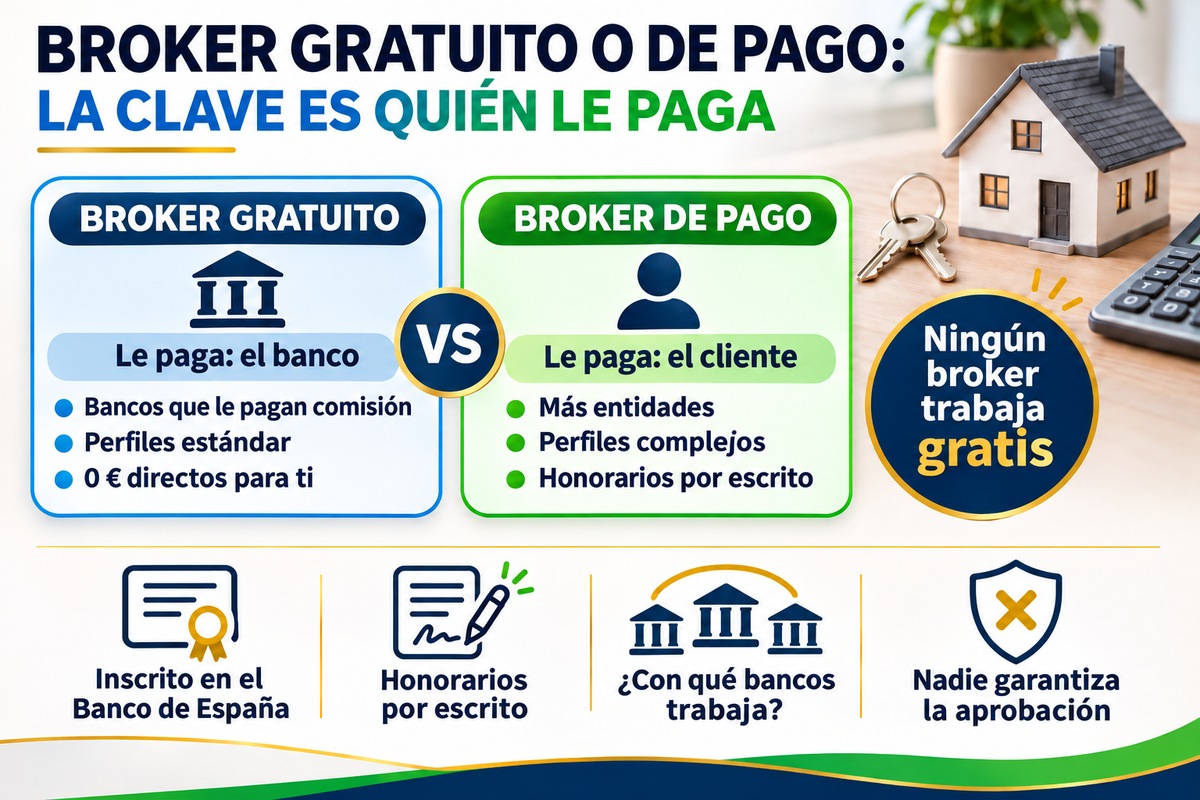
“Free and with no obligation” is the phrase you hear most often in the mortgage world. But no broker works for free: the question is not whether they charge, but who pays them. That answer determines who they work for, which banks they will present to you and how far they will go with your file. We explain the differences so you can choose wisely.
No broker is really free
A broker who does not charge you fees earns a commission from the bank you end up signing the mortgage with. It is a legal and transparent model if it is explained to you, but it has one consequence: their work is limited to the lenders that agree to pay them.
A fee-based broker charges the client fees, and in many cases also receives a commission from the bank. What matters in both models is the same: knowing exactly who pays what before you start.
The differences in service
- Who they work for — The free broker lives on the bank commission; the fee-based broker is paid by, and accountable to, the client.
- Banks they present — The free broker, usually those that pay them a commission. The fee-based broker can also present your application to lenders that do not pay intermediaries.
- Profiles they accept — The free broker tends to focus on standard profiles that banks approve easily. The fee-based broker usually takes on more complex cases.
- Time spent — A model that only gets paid if the bank signs tends to prioritise quick deals. A fee-based model allows more time to prepare and defend your file.
- Cost to you — The free broker, €0 directly. The fee-based broker, fees that on the market usually range from €3,000 to €5,000 or from 1% to 5% of the loan.
What the law requires them to tell you before starting
Since Spain's Law 5/2019, any intermediary — whether or not they charge the client — must inform you in writing, before providing the service, of:
- Their remuneration — What they will charge you or, if it cannot be set at the outset, how it is calculated.
- Bank commissions — Whether they will receive commissions or incentives from the lender and, once known, the amount.
- Whether they are tied — Whether they act on behalf of one or more specific lenders, and which ones.
- Their registration — Which register they are listed in (Bank of Spain or regional government) and how to check it.
If someone tells you it is “free” and does not explain where their remuneration comes from, that is already a warning sign.
When it pays to hire a fee-based broker
Paying fees makes sense when the broker gets you something you would not get on your own or with a free intermediary. For example:
- You need more than 80% financing — Few lenders accept it and you need to know where and how to present it.
- Your profile is not standard — Self-employed, variable income, non-residents or recent employment contracts.
- You are short on time — Signed deposit contract (arras) and a notary date coming up.
- You want to compare the whole market — Not just the lenders that pay commission.
Do the maths with the example from our article on comparing mortgages: on €180,000 over 25 years, going from 3.20% to 2.90% saves €28.17 a month, or €8,452 in interest over the life of the loan. Fees of €4,000 are more than recovered. If your bank already offers you the best conditions on the market and your profile is simple, you may not need to pay anyone.
Illustrative example using the French amortisation system. Example fees.
How to choose well, whether they charge or not
- Check their registration — In the register of the Bank of Spain or your regional government.
- Ask for the fees in writing — Amount, when they are paid and what happens if the deal is not signed.
- Ask which banks they work with — And whether they receive commission from them.
- Be wary of guarantees — No one can guarantee approval: the bank decides.
- Read the intermediation contract — Duration, exclusivity and withdrawal conditions.
The Duplo Capital advantage
At Duplo Capital we work for you. Before we start, we explain our fees in writing, adapted to your transaction, and we study your case to present it to the lenders that best suit your profile, not just the fastest ones.
Frequently asked questions about free and fee-based brokers
There is no direct cost to you, but they earn a commission from the bank you sign with. That is why they usually work with the lenders that pay them and focus on profiles that are approved easily.
On the market, fees usually range from €3,000 to €5,000 or from 1% to 5% of the loan amount, depending on how complex the transaction is. They must be given to you in writing before starting.
Not always. Paying does not guarantee a better result; what makes the difference is access to more lenders, the time spent on your file and the ability to negotiate. Ask for references and compare before choosing.
Yes, the law does not prohibit it, but it requires them to inform you in writing of what they charge you and of the commissions they will receive from the bank.
They must be registered as a real estate credit intermediary in the Bank of Spain's register or in that of their regional government. You can check it online, and they must tell you before starting.
When the savings or financing you obtain exceed what you pay: financing above 80%, self-employed or non-resident profiles, tight deadlines or when you want to compare the whole market.
Does your case need a broker? We'll tell you for free
We analyse your transaction and explain what we can achieve and with what fees, before you commit to anything.
REQUEST MY FREE ASSESSMENT